The Biggest Mistake Businesses Make on Social Media
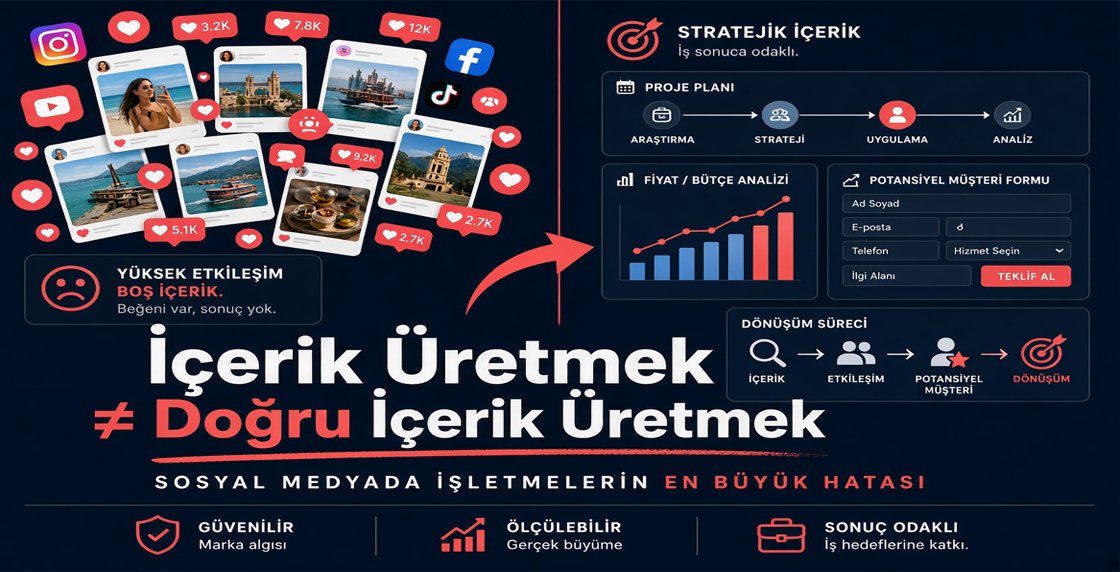
"Posting Content" Is Not the Same as "Posting the Right Content"
The most common mistake among businesses operating in a touristic region is this: they settle for "we post regularly" without ever questioning what they're posting, to whom, or for what purpose.
The result: pages with high engagement and zero revenue. A high like count feeds the owner's ego — it doesn't pay the bills.
Is Regional Content a Mistake? It Depends
There's a critical distinction here that most businesses never stop to consider.
|
|
Tourism Content about the region, its scenery, and its way of life is actually the right strategy — because in this sector, the product itself is "the destination." Making a place desirable is at the very core of the sale. |

For other sectors — construction and real estate, attractions, educational institutions — the same content strategy is a direct target miss. A real estate company posting "our region is stunning, look at this view, life is beautiful here" attracts a broad audience; but the vast majority of that audience will never buy a home, rent a property, or invest in land. What's gained is irrelevant likes, irrelevant followers, an irrelevant crowd of comments — not potential customers.
So the question isn't whether regional content is good or bad — it's which sector it's used in, for what purpose, and addressed to whom.
The Classic Mistake in Construction and Real Estate
We see this mistake most clearly in the construction and real estate sector. Promoting the city where a property is for sale or rent seems, at first glance, like it "adds value." But the buyer has already researched that city, that region, and made up their mind. What they need isn't the city's tourist attractions — it's decision-support information: the project's technical value, how the location advantage affects the sale, price-per-square-meter comparisons, delivery date, financing/payment terms, and proximity to social amenities.
A construction company that produces "how beautiful our city is" content is, without realizing it, doing the job of the city's tourism board instead of its own. This is one of the clearest signs of an amateur social media operation that has drifted away from corporate seriousness.
The First Decision in Page Management: Business or Influencer?

The most fundamental question to ask when setting up a social media account is: Will this page be a business account, or an influencer/personality account?
These two models have entirely different goals, entirely different content strategies, and entirely different success metrics:
|
|
Business Page |
Influencer Page |
|
Goal |
Potential customers, leads, sales |
Broad reach, awareness, image |
|
Target audience |
People with genuine purchase intent |
Everyone — demographics don't matter |
|
Success metric |
DMs, quote requests, conversion rate |
Likes, comments, follower growth |
|
Content focus |
Sector-specific, product/service-centered |
Lifestyle, entertainment, aesthetics |
|
Risk |
Smaller but qualified audience |
Large but unqualified audience |
When a business starts producing content without making this decision, it ends up with neither a proper corporate account nor a genuine influencer account — just a page that "looks nice but does nothing."
What Does the Right Approach Look Like, by Sector?
|
|
Tourism Region- and experience-driven content is the right call, since the product itself is the regional experience. Even so, every piece of content should end with a clear call to action (book, buy a ticket, get in touch). |
|
|
Construction & Real Estate The project, the concrete benefits of the location, pricing and payment terms, delivery timeline. Not a city tour — the value the location adds to the project. |
|
|
Attractions Experience-driven content can support the message, but it must always end in a conversion step — booking, tickets, contact. |
|
|
Educational Institutions Quality, curriculum, staff, satisfaction — a beautiful campus or setting can support the story, but it won't close the decision on its own. |




This Is Where the Difference Between a Professional and an Amateur Becomes Obvious

Professional social media management does the following:
● Decides upfront whether the account is a business page or an influencer page,
● Defines the target audience and that audience's purchase intent,
● Balances sector-specific content with supporting content in the right proportion,
● Measures success by leads and conversions — not likes.
An amateur operation, on the other hand, reassures itself with "we're posting regularly, engagement looks fine." But a social media account that doesn't bring in customers — no matter how "active" it looks — is a cost line for the business, not an investment.
Conclusion
The real skill in social media isn't posting a lot — it's posting the right thing to the right audience. Regional beauty content is the heart of the strategy for some sectors, and for others it's a distraction that contributes nothing to revenue. Businesses that can see this difference turn social media into a real sales channel; those that can't spend years saying "we're producing content" — without ever seeing results.